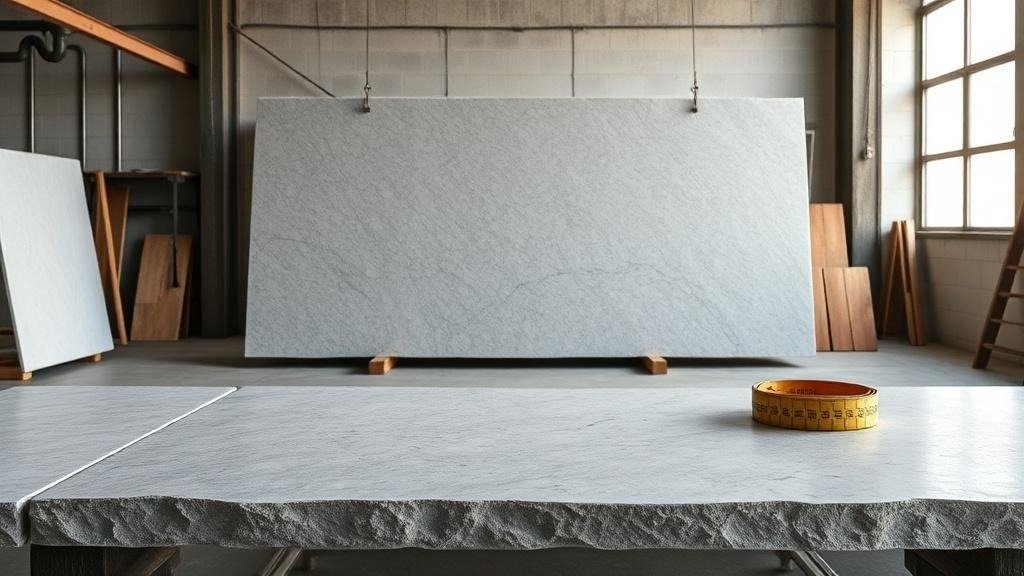
How CNC Programming Defines Countertop Edge Quality matters only if it makes quoting, layout, or production cleaner for the people doing the work. The real standard is fewer surprises between the estimate and the install.
Last fall I visited a three-man shop outside Boise where the owner, Jason, had just traded in his 2009 Park Industries bridge saw for a used Northwood C-12. He’d been hand-polishing ogee edges for eleven years. The week I was there, his lead guy ran a 14-foot ogee kitchen countertop through the CNC in about eight minutes of machine cycle. Jason held the finished piece up to the light, ran his finger along the profile, and said: “I used to spend forty-five minutes getting that edge worse than this.” That moment is the whole argument for disciplined CNC programming in a nutshell, and also the reason most of the industry conversation about CNC misses the point. The machine matters. The programming and tooling discipline matter more.
This piece is a working reference for shop owners thinking about CNC edge profiling, already running CNC and wanting to tighten their operation, or just trying to figure out what “disciplined CNC practice” actually looks like in dollars, hours, and linear feet.
Quick operational benchmarks to keep in your back pocket:
- Common stone shop CNC machines: Park Voyager 22 (22 HP spindle), Northwood C-12, Sasso AlphaSplit, Breton Combicut.
- Edge profile tooling costs: $180 to $1,200 per profile bit. Full-set tooling kits run $4,500 to $12,000.
- CNC programming time: 25 to 45 minutes per residential kitchen for an experienced operator.
- Spindle horsepower: 15 to 30 HP at 3,000 to 18,000 RPM.
- Polishing throughput on ogee profiles: 7 to 12 linear feet per machine-hour on a well-run floor.
The Problem CNC Solves (and the One It Doesn’t)
If you’re running 25 residential jobs a week and hand-polishing ogee edges, you are already behind. That’s the blunt version. Hand-finished edges top out at maybe 45 minutes per operation, with variable results that depend on who’s holding the polisher and how their Monday is going. CNC profiling and polishing collapse that into a 6 to 14 minute machine cycle and hold edge flatness to 0.005 inch when tooling is managed properly.
Capital investment for a new CNC router runs $130,000 to $480,000 depending on axis count and platform. The used market is active enough that lower-volume shops can find entry points. But here’s the catch: the machine alone doesn’t fix anything. Operator training is the long pole. A genuinely competent CNC operator takes 9 to 18 months of floor time to develop. You’re not buying a solution. You’re buying the platform for a solution that still requires people.
The numbers below (throughput, callback rate, rework, tooling cost) are the same numbers profitable shops track weekly. If you’re not tracking them, that’s a more urgent problem than which CNC you buy.
Five Phases from CAM File to Finished Part
Stone CNC fabrication runs in a predictable sequence. Where shops get sloppy is usually phases two and five.
CAM programming. Templated and nested parts get translated into machine paths. Common CAM tools include AlphaCam, MasterCam, and vendor-specific software. A residential kitchen with standard layout takes an experienced programmer 25 to 45 minutes. This is where edge profile geometry gets locked in, and where a lazy G-code approach creates rework downstream.
Tooling setup. Loading the right edge profile bits, polishing wheels, and cutout drills into the tool changer. This sounds trivial. It isn’t. Wrong bit loaded, wrong sequence in the changer, or a worn tool that should’ve been pulled three jobs ago: these are where the $180-to-$1,200-per-bit cost starts compounding into waste. Most quality failures I’ve seen trace back to setup discipline, not machine capability.
Material loading. Fixturing the slab on the CNC bed with vacuum or mechanical clamps. Vacuum tables rated for stone weight are standard. Not much to say here except that a slab that shifts mid-cycle is a slab you’re eating the cost on.
Machine cycle. The actual cut, profile, and polish. Cycle time runs 6 to 14 minutes per linear foot for standard edges. This is the part everyone fixates on. It’s important but it’s not where most shops lose money.
Quality inspection. Measuring edge flatness, profile consistency, and cutout dimensions before parts stage for install. Disciplined shops hold 0.005 inch flatness. Shops that skip or rush inspection end up with callbacks. Diamond tool life runs 80 to 220 linear feet per resharpen, so inspection is also where you catch tooling degradation before it shows up in a customer’s kitchen.
For the full operational reference covering this workflow end to end, go to https://slabwise.com/guides/cnc-fabrication-edge-profiles.
The Real ROI Is in Discipline, Not Horsepower
I’ll say the unpopular thing: a 22 HP Park Voyager run with disciplined tooling practice produces tighter edges than a 30 HP machine run without it. Shop owners love talking about spindle specs the way truck guys talk about towing capacity. But the returns from CNC show up in three categories, and none of them are “more horsepower.”
Throughput recovery. Optimizing profile cycle time from 12 minutes to 8 minutes per linear foot at a 25-job-per-week shop frees roughly 8 hours of CNC capacity per week. That’s a whole extra day of production hidden inside your existing schedule.
Edge quality and reduced hand finishing. Edge flatness held to 0.005 inch reduces post-CNC hand polishing time by up to 35 percent. That’s labor you redeploy or don’t hire for.
Tooling cost savings. This is the boring truth nobody wants to hear at trade shows. Extending diamond tooling life from 100 to 180 linear feet per resharpen (through proper feed rates, coolant management, and scheduled changeouts) cuts annual tooling cost by up to $14,000 at a typical residential shop. Fourteen thousand dollars. From tracking when your bits need resharpening. It’s not glamorous, but it’s real money.
See also: Hard Drive Shredding Chicago: Secure Data Disposal Solutions for Companies
3-Axis vs. 5-Axis: Where Most Shops Actually Land
Three categories of edge fabrication exist in practice.
Hand finishing remains viable at small shops and for genuinely unique specialty profiles. Zero CNC capital cost. The tradeoff: 45-minute operations, inconsistent quality, and a throughput ceiling that makes growth difficult.
3-axis CNC routers (Park Voyager, Northwood C-12 in 3-axis configuration) handle standard residential work at $130,000 to $260,000 capital cost. Pencil, eased, ogee, bullnose. The bread-and-butter profiles that make up 80 percent or more of residential kitchens.
5-axis CNC routers (Breton Combicut, Sasso 5-axis platforms) cover complex contoured profiles and multi-angle work at $260,000 to $480,000. Most residential shops running 25-plus jobs per week land on 3-axis as their standard platform. The 5-axis jump makes sense when your job mix genuinely demands it, not when a sales rep tells you it’s “future-proofing.”
My opinion: if you’re a residential shop doing standard profiles and you’re agonizing over 3-axis vs. 5-axis, you’re asking the wrong question. Get the 3-axis machine dialed in first. Disciplined operation on a simpler platform will outperform sloppy operation on a more capable one every time.
A 90 to 180 Day Rollout That Actually Works
Implementing disciplined CNC practice at a typical residential shop runs in four phases. The timeline is real: 90 to 180 days before you see consistent, measurable improvement.
Phase 1: Operator training (months 1 through 12-plus). New operators work alongside the lead programmer for 6 to 12 months before solo competence on residential kitchens. This overlaps with everything else. It doesn’t end when the other phases do.
Phase 2: CAM workflow documentation (weeks 2 through 6). Standard programming approaches for common edge profiles get written down. Seems obvious. Most shops don’t do it. The result is each operator reinventing the wheel on every job, introducing variation that the CNC was supposed to eliminate.
Phase 3: Tooling discipline (weeks 4 through 10). Tool life tracking, resharpening schedules, changeout protocols. This is where the $14,000 in annual savings lives. Document it. Track it. Hold people to it.
Phase 4: Metric tracking (ongoing from week 6). Throughput per machine, edge flatness, rework rate. Tracked weekly. Reviewed with the team. Not filed in a binder nobody opens. Most shops see measurable improvement within 90 days of disciplined rollout.
Silica Dust: The Non-Negotiable
Stone fabrication generates respirable crystalline silica dust during cutting, grinding, profiling, and polishing. OSHA 29 CFR 1926.1153 sets the permissible exposure limit at 50 micrograms per cubic meter as an 8-hour time-weighted average. This is not a suggestion.
Wet cutting on bridge saws, CNC routers, and waterjets is the primary engineering control. Local exhaust ventilation on dry operations (hand polishing, finish work) is the second line. Half-mask respirators with P100 filters cover residual risk where engineering controls fall short. Most trade-active shops in 2026 run quarterly air sampling on representative tasks and keep records on file for OSHA inspections.
If your shop isn’t doing air monitoring, fix that before you buy a new CNC.
A note on outside help: Owners weighing platform purchases, equipment investments, or multi-location expansion commonly benefit from a trade-experienced consultant or shop peer review before committing capital. The Natural Stone Institute, the International Surface Fabricators Association, and regional trade groups offer member resources and peer networks worth tapping.
Frequently Asked Questions
Q: How much HP does a stone CNC spindle typically run? A: Stone CNC spindles run 15 to 30 HP at 3,000 to 18,000 RPM for routing, profiling, and polishing.
Q: How long does it take to program a residential kitchen on CNC? A: Experienced CNC programmers run 25 to 45 minutes per kitchen for standard layouts.
Q: What are the most common edge profiles in 2026? A: Pencil, eased, and ogee dominate residential work. Bullnose and ogee-laminate are common upgrades.
Q: How long do CNC edge tools last? A: Diamond tooling for edge profiles runs 80 to 220 linear feet per resharpen depending on material and feed rate.
Q: Does CNC programming require a CAD background? A: Yes. Most CNC programmers come from a CAD or shop floor background and learn CAM on the job.
Q: What’s a realistic capital cost for a first CNC router? A: New 3-axis routers suitable for residential stone work run $130,000 to $260,000. The used market offers lower entry points for shops watching cash flow.
Q: How long before a new CNC operator is truly competent? A: Plan on 9 to 18 months of supervised floor time before an operator runs residential kitchens solo with consistent quality.
Stone fabrication generates respirable crystalline silica dust. Shops must follow OSHA 29 CFR 1926.1153 standards (50 ug/m3 PEL over 8-hour shift). Wet-cutting methods, ventilation, and respiratory protection are not optional.
The CNC adoption decision matters less than the disciplined CNC operation that follows it. The math on tooling life management ($14,000 in annual savings at typical residential shops) and edge quality (35 percent reduction in hand polishing time) compounds with the throughput gains. Shop owners weighing the operational lift required to move from undertrained to disciplined practice can use the numbers above as a working benchmark for a 12 to 18 month rollout.